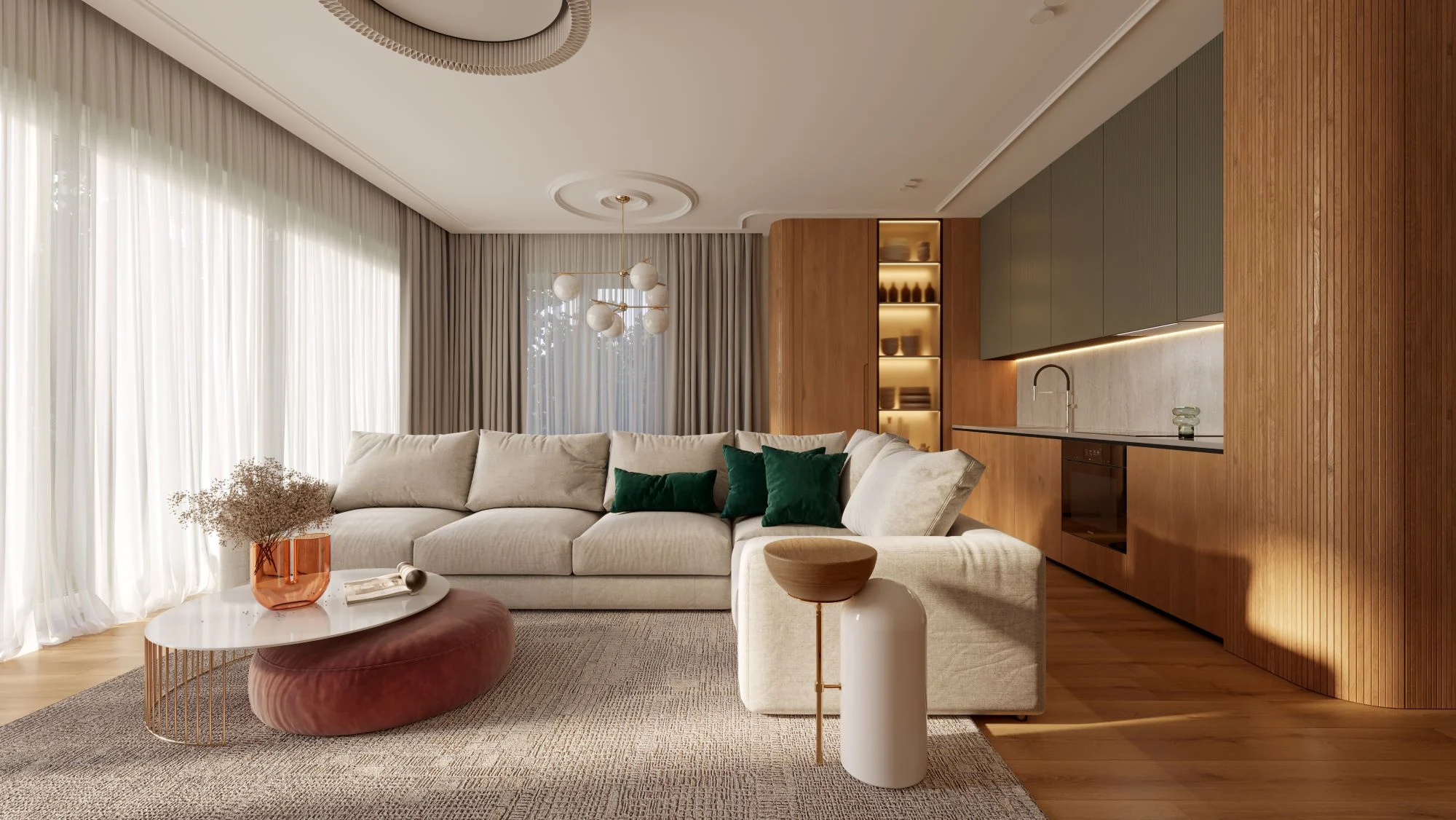
Technology
Regardless of your choice, each technology guarantees durability, safety, and the highest level of living comfort
Two approaches
to home building,
one objective: comfort
At Esencja Wilanów, you can choose the home that best suits your family’s needs and vision. We offer two unique approaches to spatial layout: a single-family home with a vertical layout - for those seeking complete independence - and apartments with a horizontal “up/down” layout, where the ground floor features a private garden and the upper floor becomes a spacious, two-level residence with terraces. This functional diversity goes hand in hand with technology: in the first phase, we focus on modern prefabrication with the highest energy efficiency standards, while subsequent phases are built using traditional masonry technology. Regardless of your choice, each technology guarantees durability, safety, and the highest quality of life.

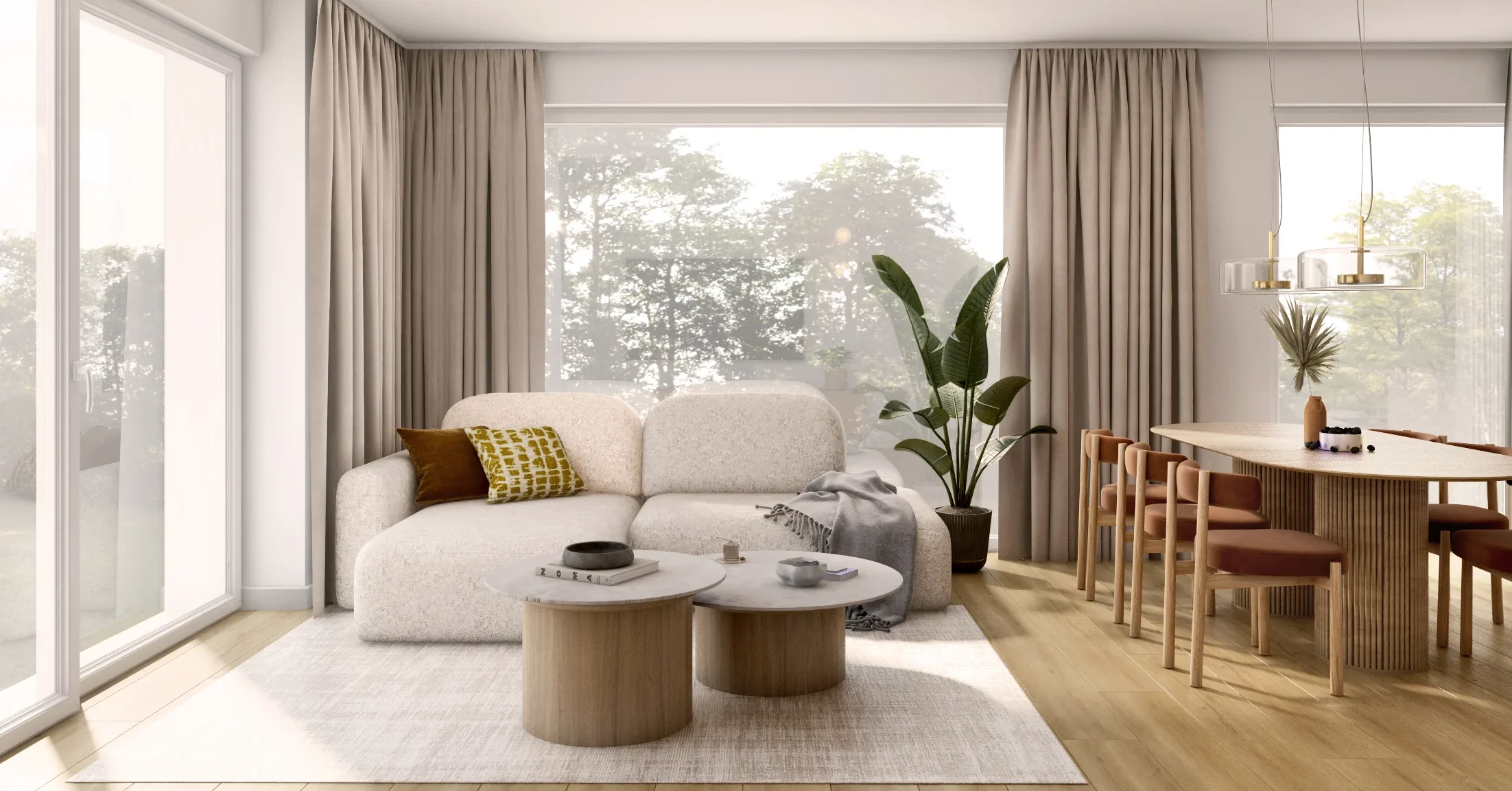
Modern prefabricated wooden construction
The warmth of wood and the precision
of technology
This is an option for those who value innovation and sustainability. These homes are built using advanced panel prefabrication technology in collaboration with the market leader - Danwood, a subsidiary of the global GS E&C Group. The millimeter-precise construction of the walls in a factory setting translates into unparalleled airtightness and energy efficiency.

Low maintenance costs
Energy efficiency of 40–70 kWh/m², resulting in a real reduction in operating costs

Highest energy standard
Compliance with the strict, recognized Effizienzhaus 40 (EH40) standard, excellent airtightness of the home, and superior insulation of all exterior walls

Heat recovery as standard
Mechanical ventilation with heat recovery ensures a constant supply of fresh air without temperature loss

Underfloor heating
Ideal temperature distribution and the absence of visible radiators increase design flexibility

Electric exterior blinds
Convenient control of comfort and privacy for all windows in the apartment

Ecology and sustainability
Buildings are designed and constructed to minimize environmental impact and support the concept of green building

Classic construction technology
Classic form, modern functionality
The buildings, constructed using traditional reinforced concrete and masonry technology, ensure solidity and durability for years to come. Depending on the architectural design, they offer various apartment layouts—Buildings B feature a horizontal layout, providing comfort in an up/down configuration, while Buildings C are designed with a vertical layout that combines apartment functionality with greater independence of use. Well-thought-out layouts, access to natural light, and the contemporary aesthetics of the facades create a comfortable alternative to a traditional home.
Solar panels
Modern energy solutions on building roofs providing free energy from renewable sources

Impressive terraces
Up to 47 m² of private terrace space in duplex apartments

Private Gardens
Homes with a vertical layout offer spacious, private gardens with an area of up to 215 m²

Master Bedrooms
Master bedrooms with private bathrooms and walk-in closets as standard

Flexible layout
Spacious interiors allowing for the creation of up to 6 rooms

Solid construction
Brick walls and reinforced concrete ceilings valued for their stability and durability
Frequently asked questions about prefabricated construction
A home’s durability depends primarily on the quality of the design, materials, and workmanship, not on the technology itself. Prefabricated homes with wooden frames are designed in accordance with the same building codes as brick homes and achieve comparable lifespans (often >100 years). Modern prefabricated homes are technologically advanced structures characterized by high durability, excellent energy efficiency, and consistent quality. Most customer concerns stem from myths associated with outdated technologies or vacation home construction.
No, if the structure is properly designed and constructed. The key is that the structure has no contact with ground moisture or precipitation—it is tightly sealed within the partitions. Modern walls are more resistant to moisture than traditional walls without insulation.
The structural elements are: • planed on all four sides (pests dislike smooth surfaces), • dried at temperatures that kill pest larvae, • structurally protected (no access for insects or rodents). In practice, a well-made prefabricated element is less susceptible to pests than damp wooden elements in a traditional construction. There is no risk of rodents getting into the insulation layers.
The structural wood used in Danwood homes comes mainly from Austria and Germany and is certified by FSC, PFCA and EPD.
The structural timber used in Danwood homes does not require chemical treatment. It remains durable and safe thanks to low moisture content, controlled production and installation conditions, and the high quality and durability of the wood species used. The panel and insulation materials used in modern prefabricated homes meet VOC and formaldehyde emission standards, which means very low emissions and good indoor air quality.
Homes manufactured by Danwood S.A. are built in modern production facilities in Bielsk Podlaski. The wooden frame is made from selected pine or spruce wood, kiln-dried to a moisture content below 16%. This makes the material naturally resistant to fungi, mold, insects, and moisture, eliminating the need for chemical treatment. Precisely cut components are sent to the production lines, where assembly and reinforcement begin. A vapor barrier protects against moisture from the interior, wood-based panels provide rigidity, and the interior of the wall is filled with non-flammable mineral wool - responsible for excellent thermal, acoustic, and fire insulation. Before leaving the production hall, each wall is given its final appearance according to the customer’s expectations - from base plaster to elegant wooden formwork. Attention to detail at this stage helps shorten the construction timeline on-site and reduce the number of crews needed at the site. At the same time, roof and ceiling components are prefabricated, enabling the efficient assembly of the entire building. All components undergo detailed quality testing - both for strength and compliance with the design documentation.
Danwood homes meet strict energy standards. Excellent thermal insulation, energy-efficient exterior doors, triple-pane windows, and mechanical ventilation with heat recovery are standard features. Esencja Wilanów homes, built using prefabricated technology, offer mechanical ventilation with heat recovery, as well as underfloor heating.
The lifespan is comparable to that of traditional construction. In developed countries, the secondary market for prefabricated homes functions normally - the value depends on the energy efficiency rating, location, and condition. Increasingly, prefabricated homes are even more valuable thanks to their energy efficiency.
Structures are designed in accordance with climate load standards. Prefabricated elements undergo the same structural calculations as masonry buildings.
Moisture does not come into contact with the structure. In wet areas, the following are used: • waterproof panels • liquid membranes • sealing tapes • waterproofing under tiles
For exterior walls, 180 mm thick square timber is used; for inter-unit and interior load-bearing walls, 180 or 120 mm thick square timber is used; and for partition walls, 80 mm thick square timber is used. The height of the floor beams is 220 mm.
12. What are the advantages of prefabricated homes? Optimized construction processes, such as industrial prefabrication and quality control, ensure efficient construction and the highest quality standards. A prefabricated timber-frame home offers unmatched benefits in terms of energy efficiency and thermal insulation. As a renewable resource, wood is also environmentally friendly: it sequesters CO₂ and thus reduces emissions. Prefabricated wooden homes are a sustainable choice for eco-conscious customers.
Insulation and thermal comfort are better than in a comparable brick home. The walls in a prefabricated building have a double layer of insulation - 200 mm of polystyrene foam on the outside and an additional 180 mm of wool inside the wooden frame.
Prefabricated walls and ceilings feature double interior wall cladding, which significantly improves sound insulation. Additionally, the walls separating apartments are double-layered, ensuring high sound insulation and quiet comfort in every room, while effectively dampening noise from outside and between rooms. Prefabricated components are manufactured under controlled conditions, ensuring precise joints and minimizing acoustic bridges. In brick homes, such precision is not always achievable on-site. The solutions used in prefabricated homes undergo acoustic testing, which confirms compliance with European noise insulation standards - as a result, their acoustics match, and often exceed, the quality of traditional homes.
No, prefabricated buildings are not flammable. Every structural wooden element is covered with an additional sheathing (gypsum board or Fermacell). The minimum fire resistance rating is REI30 (even for internal load-bearing and partition walls). The double-wall partition between apartments has a fire resistance rating of REI90, which means that for 90 minutes in a fire, the element maintains R, E, and I - that is, load-bearing capacity, integrity, and insulation. Additionally, a smoke detector is installed in every unit.
They are usually lower than in a brick house of similar size, because prefabricated buildings are more airtight and have better insulation. Actual costs depend on the systems used (heat pump, heat recovery, PV).
In prefabrication, it is easier to control the continuity of insulation and airtightness. The risk of condensation is minimal if the partitions are designed correctly and each layer is consistent in the factory. Danwood homes undergo airtightness testing on the German market. The test results significantly exceed standard requirements.
Heavy kitchen cabinets or TVs can be installed without any problems. According to the home’s user manual, installation is easier than in a brick wall - all you need is the right screw.
Danwood offers a 30-year warranty on the home’s structure and a 5-year warranty in accordance with legal requirements.
The finishing process is practically the same as in a traditional house. The assembled walls are finished on the inside with drywall, which provides an ideal base for paint, wallpaper, tiles, or other finishing materials.
Yes, Danwood homes are compatible with smart home systems for controlling lighting, heating, and security systems via an app. What’s more, the electrical wiring in Danwood homes is already prepared for the installation of SMART systems.
No, banks and insurers treat prefabricated buildings the same way they treat buildings constructed using traditional methods.